Top Walking Support Products for Global Buyers
Choosing the right walking support is no longer a narrow healthcare decision. It affects mobility, dignity, safety, and everyday independence.
The World Health Organization and UNICEF reported in the Global Report on Assistive Technology (2022) that more than 2.5 billion people need at least one assistive product. This figure may exceed 3.5 billion by 2050. The United Nations World Social Report 2023 also recorded 761 million people aged 65 and above in 2021. That number is projected to reach 1.6 billion by 2050. These trends show why global buyers need clearer product guidance.
Small details matter. A rollator’s brake handles should feel reachable, even with reduced hand strength. A cane should match the user’s height, not simply their budget. A walking frame must remain stable on the surfaces where it will actually be used. ISO 11199-1 provides relevant safety and testing requirements for walking aids operated with both arms. However, compliance alone does not guarantee comfort or practical acceptance.
This guide compares walking support products for international buyers, including canes, crutches, walkers, and rollators. It considers stability, adjustability, materials, maintenance, packaging, and user experience. Product availability and standards can differ across markets. Data also has limits. A low price may hide difficult assembly, weak after-sales service, or costly replacement parts. The best choice is rarely the most advanced one. It is the product that fits the user, environment, and care plan with dependable evidence behind it.
Types of Walking Support Products for Different Mobility Needs
Choosing the right walking support starts with the user’s mobility pattern, not the product’s appearance.
The WHO and UNICEF Global Report on Assistive Technology (2022) estimates that 2.5 billion people need at least one assistive product worldwide. That figure may reach 3.5 billion by 2050.
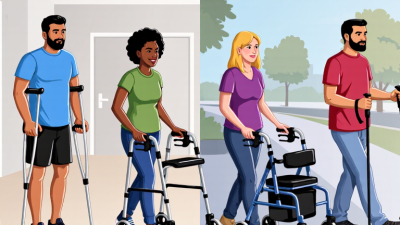
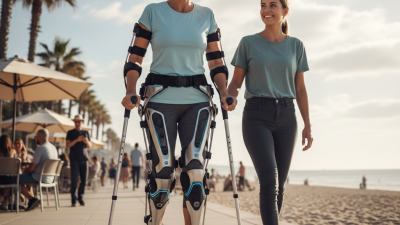
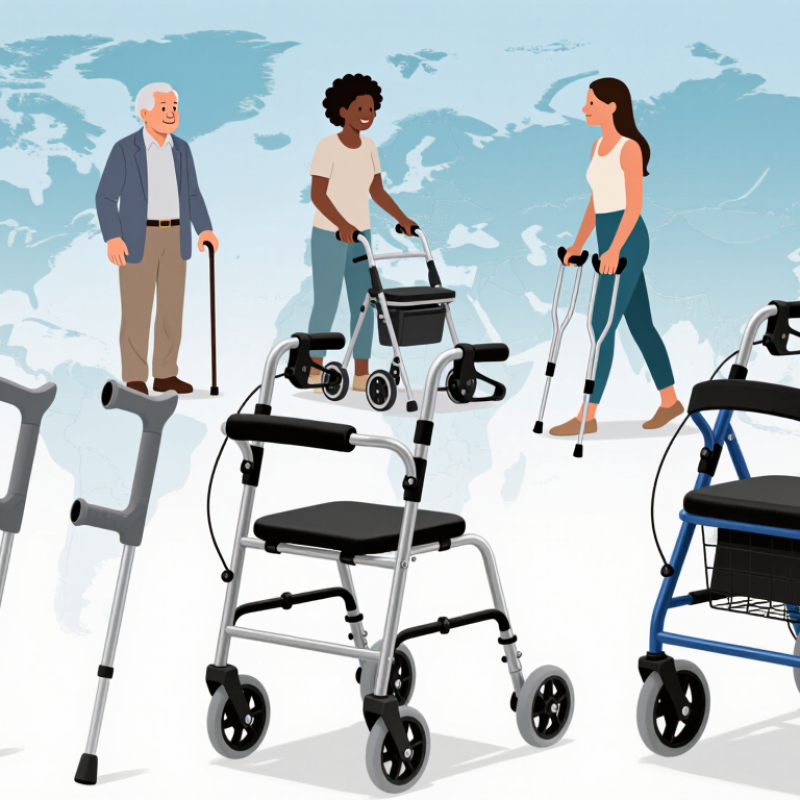
Walking canes suit people needing light balance assistance. Quad canes offer a broader base but feel slower on stairs. Crutches transfer weight away from one or both legs, making them useful after injury. They require careful height adjustment and strong upper-body control. Standard walkers provide maximum stability for cautious indoor movement. Wheeled walkers and rollators support longer distances, especially when users need a seat or storage. However, wheels can increase risk on uneven surfaces. Wheelchairs may be more appropriate when walking causes severe fatigue or pain.
Fit matters more than category. A handle should usually align near the wrist crease when the user stands upright. Elbows need a slight bend, not a locked position.
The U.S. CDC reports that more than one in four adults aged 65 and older falls each year. Support products cannot remove every hazard.
Loose rugs, poor lighting, and incorrect footwear still matter. A product may look ideal online yet feel unstable in a real hallway. That is an easy point to overlook. Global buyers should check load ratings, adjustment ranges, replacement parts, and applicable safety standards before purchasing.
Key Features to Compare Before Choosing a Walking Aid
Top Walking Support Products for Global Buyers
Key Features to Compare Before Choosing a Walking Aid
Choosing a walking aid should begin with fit, not appearance. Measure handle height while standing naturally, with relaxed shoulders and slightly bent elbows. A poor fit can cause wrist pressure, back strain, or uneven steps. Check the user’s weight capacity, walking ability, and daily environment. A product for smooth indoor floors may perform poorly on gravel or wet pavement.
Frame stability matters during real use. Test the handle grip with dry and slightly damp hands. Rubberized surfaces often feel more secure, but some grips may become uncomfortable during long walks. Check wheel size, brake response, and locking strength. Small wheels can catch on door thresholds. Brakes should engage smoothly, without excessive force. A seat may help during outdoor trips, yet it can add weight and reduce lifting comfort.
Portability also deserves close attention. Fold the aid several times and check whether the latch feels secure. Measure its folded size before planning car or storage space. Materials should resist ordinary moisture and frequent handling. Still, durability claims need practical evidence, not attractive wording. User manuals, load testing information, and clear care instructions improve buying confidence. A healthcare professional can assess posture and gait when uncertainty remains. The best choice may feel slightly awkward at first; that discomfort deserves investigation, not quick dismissal.
Safety Standards and Quality Factors for Global Buyers
Top Walking Support Products for Global Buyers
Safety Standards and Quality Factors for Global Buyers
A walking aid should match the user, not simply look strong. Check height adjustment, handle comfort, base width, and weight capacity. A cane with a loose pin can fail quietly. That small detail matters.
Global buyers should request material specifications, load-test results, and inspection records. Relevant medical-device standards can guide product selection, but one certificate may not cover every market. Confirm local import, labeling, and safety requirements before placing an order. Independent laboratory testing offers stronger evidence than a supplier’s sales statement. Still, documents can become outdated. Check issue dates and product model numbers.
Quality also appears in ordinary handling. Rubber tips should grip dry floors without leaving heavy marks. Walker joints should open smoothly and lock firmly. Aluminum tubing needs clean welds, even surfaces, and no sharp edges. Packaging should protect adjustment parts from impact and moisture. Sample testing is essential because production batches sometimes vary. A product may pass one inspection and disappoint users later. Keep inspection photos, batch records, and replacement-part policies. Ask how quickly damaged tips, bolts, or grips can be supplied. Field feedback from therapists, distributors, and older users can reveal problems that laboratory tests miss. A practical review should notice both measurable safety and daily frustration.
How to Select the Right Walking Support Product
Top Walking Support Products for Global Buyers
How to Select the Right Walking Support Product
Choosing a walking support product starts with the user, not the product label. Assess balance, leg strength, joint pain, hand grip, and typical walking surfaces. A cane may suit mild instability, while a walker can offer broader support. However, the lightest option is not always the safest. That assumption deserves scrutiny.
Measure handle height while standing upright, with relaxed shoulders and slightly bent elbows. Poor height can increase wrist pressure or encourage stooping. Check the base, frame width, wheel design, brakes, and grip texture. For outdoor use, test stability on ramps, uneven pavement, and wet floors. Indoor users may value a narrow frame and easy turning more. A product should fit the person’s routine, not an ideal showroom floor.
Ask a physiotherapist or trained mobility adviser to review the fitting and walking pattern. This professional check is especially important after surgery, repeated falls, or major weakness. Global buyers should confirm load ratings, replacement-part access, instructions, and applicable safety requirements. Packaging and adjustment guidance should be clear in the buyer’s language. Read return terms carefully, since comfort often becomes apparent after several days. I would not trust a support product that feels unstable, even if its specifications look impressive. Real-world use exposes flaws that a product page may miss.
Top Walking Support Products for Global Buyers
How to Select the Right Walking Support Product
This chart compares the typical number of ground-contact points in standard configurations.
More contact points generally provide a broader support base, while wheeled designs can improve
maneuverability. Buyers should also verify user weight capacity, product fit, braking features,
terrain suitability, and local safety requirements before selecting a product.
Buying, Shipping, and Maintenance Considerations Worldwide
Top Walking Support Products for Global Buyers
Buying a walking aid requires more than comparing prices. Canes, crutches, walkers, and rollators serve different balance and mobility needs. Fit matters. Handle height should support an upright posture, while the frame must match the user’s weight and daily environment. In practical fitting work, adjustable models usually reduce errors. However, adjustment instructions are often unclear. Buyers should request measurements, load ratings, grip materials, wheel sizes, and replacement-part details before ordering.
Shipping creates another layer of risk. A compact folding walker may lower freight costs, but hinges need strong protection. Moisture-resistant packaging helps during long sea or air routes. Check carton dimensions, estimated delivery time, insurance options, and customs documents with the supplier. Some destinations also require product testing or safety paperwork. Requirements differ widely, so local verification remains essential. A low quoted price can become expensive after storage fees or damaged-goods claims.
Maintenance should be planned before purchase. Rubber tips, wheels, brakes, bolts, and hand grips need regular inspection. Users should test brakes on a dry, level surface and replace worn parts promptly. Keep moving joints clean, but avoid excessive lubricant near braking systems. This detail is easy to miss. Service access also matters; imported products may lack compatible parts locally. I once underestimated this issue when evaluating a folding frame. The frame performed well, yet a small replacement tip took weeks to obtain. Availability is not a minor detail.