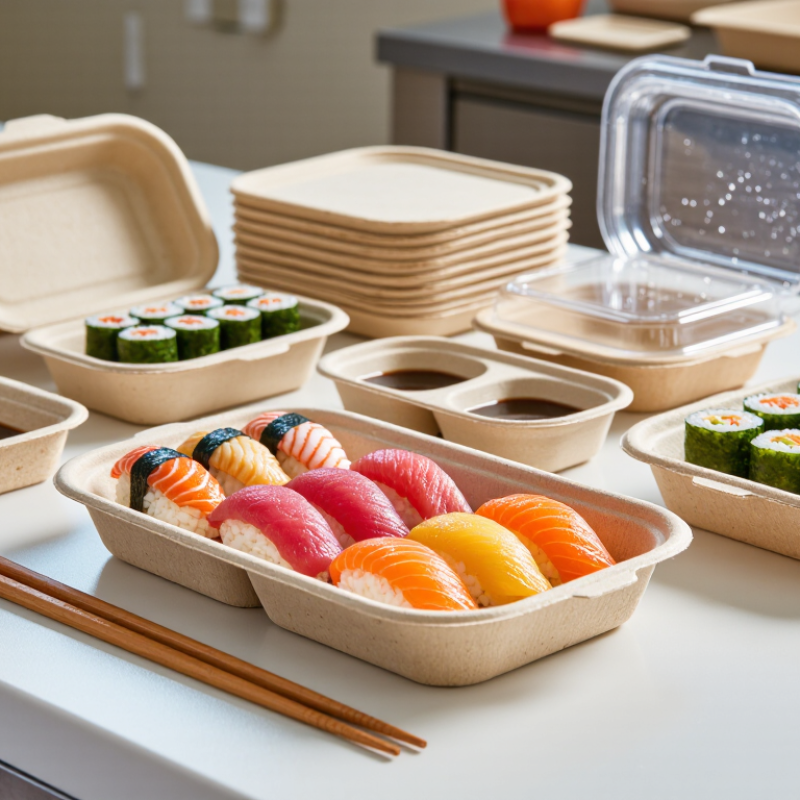
| Raw Material | Source and consistency of the molded-fiber material used for the sushi tray. | Use food-contact-grade bagasse pulp made primarily from sugarcane fiber. The supplier should be able to explain pulp preparation, additives, and the control of recycled or non-food-contact fibers. | Request raw-material specifications, supplier declarations, batch records, and a description of the pulping process. | High |
| Food-Contact Safety | Suitability for direct contact with sushi, rice, vegetables, sauces, and other foods. | The finished tray should comply with the food-contact requirements applicable in the destination market. Testing should cover overall migration and any relevant restricted substances based on the intended food type and temperature. | Review current third-party laboratory reports, declarations of compliance, material composition, and testing scope. Confirm that reports match the actual product and production site. | High |
| Tray Dimensions | Length, width, depth, compartment layout, and compatibility with the customer’s sushi portions. | Choose a standard size or approve a custom mold according to the required sushi count, portion size, sauce cup position, and packing method. Dimensional tolerance should be defined in the product specification rather than left unspecified. | Check approved drawings, dimensional inspection records, first-article samples, and measurements from multiple production batches. | High |
| Product Weight | Fiber weight per tray and its effect on strength, cost, and transport efficiency. | Set a target weight with an agreed tolerance. A heavier tray is not automatically better; the correct weight depends on tray size, stacking height, moisture exposure, and required rigidity. | Weigh samples from at least three production batches and compare the results with the approved specification. | Medium |
| Structural Strength | Resistance to bending, cracking, deformation, and stacking pressure. | The tray should remain stable during filling, lidding, stacking, transport, and display. Acceptance limits should be established through compression, flexural, and practical handling tests for the intended load. | Request test methods and results, then conduct filled-tray and stacked-tray trials using the actual sushi weight and packaging configuration. | High |
| Moisture Resistance | Performance when exposed to chilled food, condensation, sauces, and short-term liquid contact. | Bagasse is naturally absorbent. If the tray is intended for moist foods or sauces, verify whether a suitable food-contact coating or barrier is used and whether it is accepted in the destination market. | Perform liquid-holding, condensation, leakage, and surface-softening tests under the planned storage conditions. Request coating composition and compliance documents where applicable. | High |
| Temperature Performance | Suitability for chilled storage, room-temperature display, reheating, or other planned uses. | Do not assume that all bagasse trays are suitable for microwave, oven, freezer, or hot-food applications. The supplier should define tested temperature conditions and maximum contact time. | Review product technical data and conduct tests at the actual minimum and maximum temperatures used in the supply chain. | High |
| Lid Compatibility | Fit, closure force, sealing performance, and stackability with the selected lid. | The lid should close securely without crushing sushi and should not detach during normal handling. The supplier should provide a compatible lid specification or support fit testing with the customer’s lid. | Carry out opening-force, drop, vibration, stacking, and transport simulations with filled trays and the final lid. | High |
| Surface and Appearance | Color, smoothness, edge quality, odor, visible fibers, pinholes, and molding marks. | A consistent natural fiber appearance is acceptable when agreed in advance. Trays should be free from sharp edges, loose fibers, foreign particles, objectionable odor, and visible defects that affect food presentation. | Approve a golden sample, define acceptable defect limits, and inspect samples under consistent lighting. | Medium |
| Odor and Taste Transfer | Unwanted odor from pulp, processing aids, coatings, printing, or storage. | The tray should not impart an unacceptable odor or taste to sushi. Odor risk should be assessed especially when the product contains coatings, inks, adhesives, or recycled fibers. | Use sensory screening and review relevant food-contact or organoleptic test results from an accredited laboratory. | High |
| Compostability Claims | Whether the tray can be described as compostable or biodegradable in the target market. | Do not rely on the word “bagasse” alone. Compostability depends on the full product, including coatings, inks, adhesives, and the conditions defined by the applicable standard. Industrial and home composting claims are not interchangeable. | Request certification or test reports for the finished tray and verify the applicable standard, scope, certificate validity, and disposal conditions. | High |
| Chemical Restrictions | Presence of substances restricted by the destination market or customer policy. | Ask for controls covering restricted substances relevant to fiber food packaging, including heavy metals, fluorinated treatments where applicable, and other substances specified by the buyer or local regulations. | Review a current restricted-substance declaration and independent laboratory testing based on a documented risk assessment. | High |
| Manufacturing Capacity | Ability to produce the required volume without compromising quality or delivery time. | Evaluate installed molding capacity, number of production lines, shift arrangements, raw-material availability, preventive maintenance, and contingency planning. Capacity claims should be based on the specific tray size and mold. | Request a capacity statement, production schedule example, lead-time history, and an audit of the relevant manufacturing area. | High |
| Minimum Order Quantity | Minimum order for standard products, custom molds, colors, coatings, and packaging configurations. | Compare the minimum order with forecast demand and inventory limits. Custom designs commonly require separate mold, tooling, sampling, and production commitments. | Obtain a written quotation showing minimum order quantities, tooling charges, sampling fees, and conditions for repeat orders. | Medium |
| Tooling and Development | Design support, mold ownership, prototype quality, and change-control procedures. | The supplier should provide controlled technical drawings, prototype samples, mold-maintenance plans, and clear ownership terms for custom tooling. | Review the development timeline, sample approval process, mold agreement, and change-notification procedure. | Medium |
| Quality Management | Consistency of incoming materials, in-process controls, final inspection, and corrective actions. | Look for documented inspection procedures covering dimensions, weight, appearance, moisture performance, packaging, and traceability. Nonconforming products should be isolated and investigated. | Request quality manuals, inspection checklists, batch records, corrective-action examples, and audit access where appropriate. | High |
| Batch Traceability | Ability to identify the production date, raw-material batch, mold, line, and inspection records. | Every shipment should be traceable to a defined production batch and packaging label. Traceability should support a timely investigation or recall if required. | Perform a traceability exercise from a finished carton back to raw materials and production records. | High |
| Packaging and Logistics | Protection against crushing, moisture, dust, and contamination during storage and transportation. | Use clean, dry, protective outer packaging with suitable stacking limits. Confirm carton dimensions, units per carton, pallet pattern, gross weight, and storage requirements before ordering. | Inspect shipping cartons, review packing specifications, and conduct a transport simulation or trial shipment where practical. | Medium |
| Lead Time | Time required for sampling, tooling, production, inspection, and shipment. | Separate the lead time for standard products from the lead time for custom products. Include approval time, mold fabrication, production scheduling, quality inspection, and international transportation. | Request a milestone-based delivery schedule and compare promised dates with documented previous performance. | High |
| Total Cost | Product price plus tooling, testing, packaging, freight, storage, and potential quality costs. | Compare suppliers using landed cost rather than unit price alone. Include expected scrap, inspection, customs, transport, and the cost of any required coating or certification. | Prepare a total-cost comparison using the same specifications, order volume, Incoterm, delivery location, and testing requirements. | High |
| Sustainability Data | Environmental impact, renewable-fiber content, energy use, water use, waste handling, and packaging materials. | Prefer specific, verifiable environmental data over broad claims. Bagasse is a sugarcane-processing residue, but the full environmental profile also depends on manufacturing, coatings, transport, and end-of-life conditions. | Request environmental declarations, material-content information, waste-management records, and evidence supporting any sustainability statement. | Medium |
| Supplier Communication | Technical responsiveness, document accuracy, English communication, and speed of corrective action. | A reliable supplier should answer specification questions clearly, provide consistent documents, identify limitations honestly, and respond with a documented corrective-action plan when problems occur. | Use a prequalification questionnaire, technical meeting, sample-review process, and response-time record before signing a long-term agreement. | Medium |